Barbecue Sauce on Pizza: Ratios That Stay Balanced
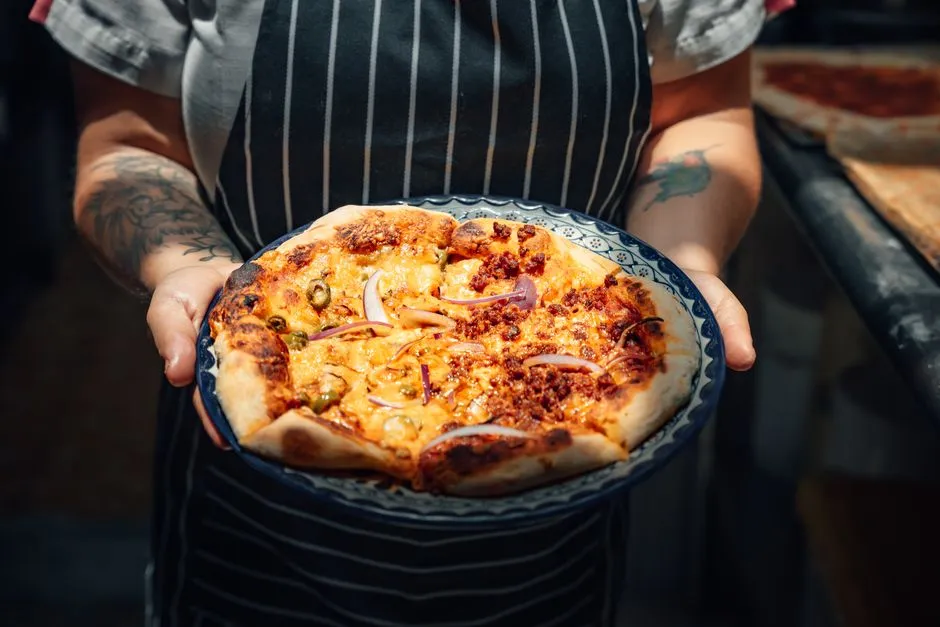
- Start with a 1:1 blend and a thin layer
- A ratio table for one 12-inch pizza
- Scale BBQ pizza sauce by surface area
- Taste across five dimensions
- Tomato is dilution with benefits
- Match cheese to intensity
- Meat must be cooked before it becomes a topping
- Acid is the antidote to sweet and rich
- Vegetarian combinations need moisture control too
- Keep sauce off direct grill heat
- Fix the mixture before it reaches dough
- Storage and cross-contamination matter
- Sources
Start with a 1:1 blend and a thin layer
For one 12-inch pizza, mix 60 grams thick barbecue sauce with 60 grams plain crushed tomato. Spread the resulting 120 grams thinly, leaving a 1-centimetre rim. That 1:1 ratio softens concentrated sweetness, salt, smoke, and spice without hiding the barbecue character.
Then build with 180–240 grams mild melting cheese, no more than 180 grams fully cooked and drained meat, and one acidic or fresh counterpoint. Taste the actual sauce first. Brands and homemade recipes vary too much for the label word “barbecue” to settle dinner by itself.
Straight sauce can work, but use less—about 75–90 grams—and watch it closely around high heat. Its concentrated sugars can scorch on an exposed rim or hot baking surface.
A ratio table for one 12-inch pizza
| Sauce character | Barbecue sauce | Plain crushed tomato | Total | Best adjustment |
|---|---|---|---|---|
| Very sweet or smoky | 40 g | 80 g | 120 g | Add pickled or fresh acid |
| Balanced, medium intensity | 60 g | 60 g | 120 g | Use as the baseline |
| Thin and tomato-forward | 70 g | 40 g | 110 g | Reduce briefly if watery |
| Sharp and vinegary | 70 g | 50 g | 120 g | Choose round, mild cheese |
| Undiluted, thick sauce | 75–90 g | 0 g | 75–90 g | Spread especially thinly |
These are starting formulas, not universal truths about named regional sauce traditions. Ingredients, sugar concentration, salt, smoke flavour, and water content vary. Write down which sauce you used and what you changed; “the brown bottle” is weak laboratory documentation.
Scale BBQ pizza sauce by surface area
The 120-gram baseline belongs to a 12-inch round. If the crust diameter changes, scale by area rather than by diameter: new sauce weight = 120 g × (new diameter ÷ 12)². A 14-inch pizza is only 16.7% wider than a 12-inch pizza, but its circular surface is about 36.1% larger.
For the 1:1 barbecue-and-tomato blend, whole-gram starting amounts are:
| Pizza diameter | Area factor versus 12-inch | Barbecue sauce | Crushed tomato | Total sauce |
|---|---|---|---|---|
| 10 inches | 0.694 | 42 g | 42 g | 84 g |
| 12 inches | 1.000 | 60 g | 60 g | 120 g |
| 14 inches | 1.361 | 82 g | 82 g | 164 g |
| 16 inches | 1.778 | 107 g | 107 g | 214 g |
The arithmetic is an editorial scaling tool, not a universal formula. A thick pan pizza, a very thin centre, a heavily topped pie, and a par-baked or grilled crust do not manage moisture identically. Hold back roughly 10% of the calculated amount, spread to the intended rim, and add only what the dough can carry in a thin, continuous layer.
If you use undiluted thick barbecue sauce, scale the 12-inch range of 75–90 grams the same way: about 52–63 grams for 10 inches, 102–123 grams for 14 inches, or 133–160 grams for 16 inches. Start at the lower end when the sauce is especially sweet, salty, or smoky.
Read the layer before adding toppings
| What the spread does | Likely issue | First correction |
|---|---|---|
| Leaves bare streaks and drags the dough | Sauce may be too thick or too cold | Blend with plain crushed tomato; do not force extra weight onto the crust |
| Runs toward the centre or edge | Too much free water or too much sauce | Reduce briefly, cool completely, and reweigh |
| Forms a deep glossy layer | Weight is high for the available area | Remove sauce before adding cheese and toppings |
| Looks even but tastes dominant | Concentration, not coverage, is the problem | Keep the thin layer and change the barbecue-to-tomato ratio |
This separates two different fixes. More tomato can reduce concentration, while less total sauce reduces moisture and weight. Treating those as the same adjustment makes troubleshooting harder.
Taste across five dimensions
Put a teaspoon of sauce on a plain piece of bread or unsalted cracker. Notice:
- Sweetness: Does sugar arrive first and linger?
- Acid: Is it tomato-bright, vinegar-sharp, or flat?
- Salt: Will cheese and meat push it too far?
- Smoke: Is it gentle, dominant, or artificial-tasting to you?
- Heat: Does chile support flavour or erase it?
The topping plan should answer what the sauce already does. Sweet sauce wants acid and restraint. Sharp sauce welcomes creamy cheese. Smoky sauce needs less smoked meat. Salty sauce calls for fewer cured toppings.
Do not “balance” an intense sauce with more of everything. That is how a 12-inch pizza becomes a small loud county fair.
Tomato is dilution with benefits
Plain crushed tomato lowers the concentration of sugar, salt, and smoke while preserving body and acidity. Choose tomato without heavy seasoning so it does not introduce a second competing sauce formula.
If the mixture is watery, simmer it over moderate heat until it mounds lightly on a spoon, then cool completely before topping proofed dough. Hot sauce warms and weakens the surface, while excess water delays setting.
Do not use tomato paste as a 1:1 substitute for crushed tomato. Paste is far more concentrated. If paste is all you have, whisk 20 grams paste with 40 grams water for a simple 60-gram tomato component, then combine with 60 grams barbecue sauce. Taste and adjust; paste brands vary in concentration and salt.
For our smoked brisket pizza, the baseline 60-plus-60 mixture supports 180 grams meat without turning the slice sweet or dry.
Match cheese to intensity
Low-moisture whole-milk mozzarella is the dependable base. It melts evenly and contributes enough fat and salt without trying to become a second sauce. Use 180 grams on a 12-inch pizza.
Add 40–60 grams mild or medium cheddar when you want a sharper edge. Keep cheddar below roughly one third of the total cheese; large quantities can release oil and dominate. Monterey Jack is a softer alternative.
Smoked cheese can be redundant beside smoked sauce and brisket. Use 20–30 grams as an accent if the other elements are restrained. Blue cheese is similarly powerful. Fresh mozzarella brings more water; drain, blot, and use in small patches.
Every dairy cheese contains milk. Vegan shreds vary in melting and browning, so follow their package directions and use a modest amount. Check all packaged foods for allergens and cross-contact relevant to the diner.
Meat must be cooked before it becomes a topping
Barbecue pizza is not a safe place to finish raw meat. The crust and cheese can brown before hidden pieces reach a safe centre.
Use fully cooked toppings:
- beef, pork, lamb, and veal steaks, chops, and roasts cooked to 145°F (63°C) with at least a three-minute rest where applicable;
- ground beef or pork and their sausages cooked to 160°F (71°C);
- chicken, turkey, and poultry sausage cooked to 165°F (74°C).
Then drain excess fat and cool the pieces briefly before topping. Keep raw-meat boards, knives, marinades, and hands away from cooked meat, cheese, sauce, and dough.
For leftovers, the finished pizza should reheat the centre to 165°F (74°C). Use a clean thermometer inserted into the thickest topping area without touching a hot stone or pan.
Acid is the antidote to sweet and rich
Choose one or two from this list:
- 20–40 grams drained pickled jalapeño;
- 30–50 grams thin red onion;
- 20–30 grams chopped dill pickle after baking;
- quick-pickled onion, thoroughly drained;
- fresh coriander after baking;
- a restrained squeeze of lime after baking.
Pickled jalapeño contributes acid and heat, though individual heat still varies. Dill pickle brings sharper acidity without chile. Red onion becomes sweeter in the oven, so use it with an already sharp sauce rather than expecting it to correct sweetness.
Do not combine pickle, pickled onion, jalapeño, lime, and three hot sauces simply because they all live in this paragraph. Contrast needs space to be noticed.
Vegetarian combinations need moisture control too
Barbecue sauce works with vegetables and pulses when they arrive cooked and dry enough:
| Combination | Preparation before topping | Finish |
|---|---|---|
| Mushroom and roasted poblano | Brown mushrooms until liquid evaporates; roast and drain pepper | Pickled onion |
| Corn and black bean | Char corn; rinse and dry cooked beans | Coriander and lime |
| Sweet potato and jalapeño | Roast 1-centimetre cubes until tender | Spring onion |
| Cauliflower and cheddar | Roast small florets until browned | Dill pickle |
Keep cooked vegetable and pulse toppings around 180–220 grams total on a 12-inch pizza. Large piles trap steam, insulate the centre, and make launching harder.
Check the barbecue sauce itself for honey, Worcestershire sauce containing fish, dairy, gluten sources, or other ingredients that affect the diner. “Vegetarian toppings” cannot reform the sauce by proximity.
Keep sauce off direct grill heat
For two-zone grilled pizza, cook one side of the bare dough over direct heat first. Flip it onto the indirect zone, then apply no more than 60 grams sauce to a 10-inch round. Keep the outer centimetre bare and close the lid to melt toppings.
Never spread sauce before the first side touches the grate. Drips burn, stick, and flare. If a drip occurs, move the pizza away from flame and follow the grill manufacturer’s flare-up guidance. Do not spray water into a hot grease or fuel fire.
Oven pizza is more forgiving, but sugary sauce can still blacken where it spills onto a hot stone or exposed rim. Launch cleanly. Wipe the stone, steel, pan, or oven surface only after the equipment has cooled according to its manufacturer instructions; do not reach into a hot oven to clean a spill.
Fix the mixture before it reaches dough
Too sweet
Add plain crushed tomato 15 grams at a time. Increase acid with a small amount of vinegar or lemon only after tasting. Plan a pickled topping and avoid sweet onions, pineapple, candied bacon, or sugary glaze.
Too smoky
Dilute with tomato and use plain cooked chicken, mushrooms, or vegetables instead of smoked meat. Choose mozzarella without smoked cheese.
Too salty
Dilute with unsalted tomato. Use lower-salt cheese and fresh rather than cured toppings. Do not rely on extra sugar, which can make the sauce both salty and sweet.
Too thin
Simmer to reduce, then cool. Do not thicken casually with flour; raw flour requires cooking and can make the sauce pasty. A watery sauce should not be repaired by adding twice as much cheese.
Too hot
Dilute with tomato and serve cooling dairy or a suitable nondairy alternative on the side. Do not promise any pepper or sauce is mild; sensitivity varies.
Storage and cross-contamination matter
Follow the barbecue sauce label after opening. Refrigerate homemade sauce promptly and use the storage guidance from its tested recipe. Never return a brush that touched raw meat to a clean sauce container.
The simplest barbecue practice is to divide sauce before cooking: one portion for raw-meat application and one untouched portion for pizza or serving. Discard contaminated sauce unless a validated cooking method specifically makes it safe.
Refrigerate finished pizza within two hours, or within one hour above 90°F (32°C), and use within 3–4 days. Reheat to 165°F (74°C). When the topping contains older leftovers, the original cooking date controls the storage window; baking does not reset the calendar.
The larger regional context is in our honest definition of Texas-style pizza. It comes down to the same discipline: name what you are doing, measure the loud ingredients, and give smoke enough room to be interesting rather than enough room to rent the whole building.
Sources
- FoodSafety.gov, Cook to a Safe Minimum Internal Temperature — supports 145°F (63°C) plus a three-minute rest for the named whole cuts, 160°F (71°C) for ground meat and sausage, and 165°F (74°C) for poultry and leftovers. Accessed September 4, 2026.
- FoodSafety.gov, Food Safety and Eating Out — supports refrigeration within two hours, or one hour above 90°F (32°C), and the three-to-four-day refrigerated leftover window. Accessed September 4, 2026.
- USDA Food Safety and Inspection Service, Grilling and Food Safety — supports reserving clean sauce before raw-meat contact and boiling a used marinade before reuse. Accessed September 4, 2026.
- U.S. Food and Drug Administration, Flour Is a Raw Food — supports treating flour as raw and not tasting uncooked dough. Accessed September 4, 2026.
- U.S. Food and Drug Administration, Food Allergies — supports reading packaged-food labels for major allergens and recognizing cross-contact as distinct from an intentional ingredient. Accessed September 4, 2026.